
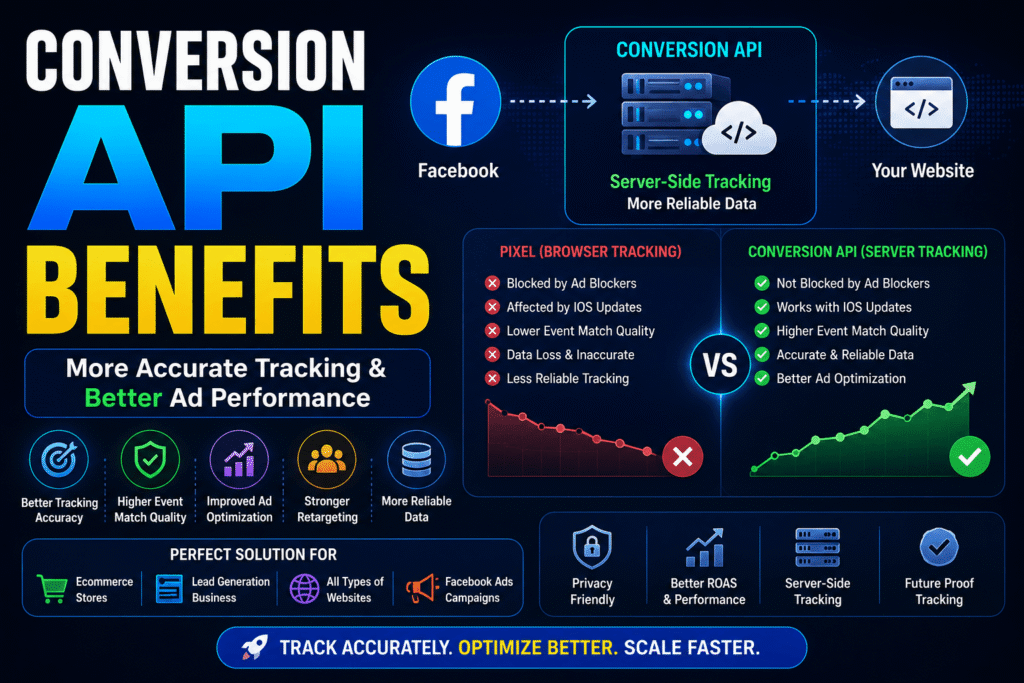
Meta Conversions API can help businesses send selected website or customer action events through a server-side or integration-based path instead of relying only on browser-side tracking. Its main benefit is better event-signal resilience when browser tracking is limited, but it does not create perfect tracking, guarantee attribution accuracy, or guarantee better campaign performance.
What is Meta Conversions API?
Meta Conversions API, often called CAPI, is a way to send supported event data from a server, website platform, partner integration, or another approved connection to Meta. These events can help Meta receive information about actions such as leads, contact actions, checkout steps, purchases, or other business events when the implementation is configured correctly.
CAPI is usually discussed with Meta Pixel because both can send event signals related to website activity. The Pixel is browser-side tracking, while CAPI uses a server-side or integration-based event path. For a deeper comparison, read the Meta Pixel vs Conversions API comparison.
Key benefits of Conversions API
The benefits of Conversions API should be understood as measurement and signal-quality advantages, not automatic business-performance promises.
More resilient event transmission
Browser-side tracking can be affected by browser settings, connection issues, script blocking, page behavior, consent choices, and implementation problems. A server-side or integration-based event path can make important event transmission more resilient in suitable setups.
Improved event coverage where appropriate
CAPI can help send supported events that may not be captured reliably through the browser alone. This can be useful for lead generation, e-commerce, checkout flows, form submissions, and contact actions, depending on the website and available data.
Stronger data matching when configured responsibly
Meta supports customer information parameters that can help match events when they are collected and sent appropriately. These parameters must be handled carefully and should reflect the business’s consent, privacy, and data-handling requirements.
Better control over event architecture
For businesses that rely heavily on advertising measurement, CAPI can support a more deliberate event architecture. Teams can decide which events matter, how browser and server events relate, and how conversion data should be reviewed before campaign decisions are made.
What Conversions API does not solve
Conversions API is not a shortcut to complete attribution certainty. It does not guarantee that every event will be captured, that every platform report will match the store or CRM, or that campaigns will automatically produce better results.
CAPI also does not remove the need for proper consent practices, accurate event setup, clear naming, deduplication where needed, testing, diagnostics, and business-level interpretation. It improves the tracking foundation only when the implementation is planned and verified carefully.
Does Conversions API replace the Meta Pixel?
Conversions API does not universally replace the Meta Pixel. In many website setups, Pixel and CAPI are used together because they can send related signals from different paths. The right setup depends on the website, platform, data available, privacy requirements, campaign goals, and technical access.
If both browser and server paths send the same customer action, the implementation must account for duplicate events. That is where deduplication becomes important.
Why deduplication matters
Deduplication helps Meta understand when a browser event and a server event represent the same customer action. At a high level, this usually means the implementation needs consistent event information so duplicated versions of the same action can be recognized rather than counted as separate events.
This article is not a technical installation guide. The important business point is simple: if Pixel and CAPI both send the same action, deduplication should be planned and tested.
When businesses should consider CAPI
A business should consider Conversions API when advertising decisions depend on website events, lead actions, purchase events, or other conversion signals that need a stronger measurement foundation.
- The business runs Meta Ads and depends on lead, purchase, checkout, or contact events.
- Browser-only tracking appears incomplete or unstable.
- The website uses e-commerce, forms, CRM flows, or landing pages where conversion events matter.
- The business needs cleaner retargeting and event-based audiences where permitted.
- The team has enough access to verify events after implementation.
For WooCommerce-specific implementation context, use the WooCommerce tracking setup guide.
How to verify a Conversions API implementation
Verification should focus on whether the intended events are being sent, whether browser and server events are named correctly, whether duplicate events are handled, and whether diagnostics show issues that need attention.
Useful review areas include event names, event timing, event IDs or deduplication setup where applicable, customer information parameters, testing tools, diagnostics, and comparison with website or operational records.
What businesses should expect after setup
A good CAPI implementation can improve the quality and resilience of event signals. It should make measurement more dependable than a weak browser-only setup, but it should still be interpreted alongside website data, CRM records, order records, and business context.
If Meta Ads Manager, the website, and operational reports show different numbers, that does not always mean tracking is broken. Different systems can measure different events with different rules. For that topic, read why Meta and website numbers do not match.
Need implementation help?
If your business needs Meta Pixel, Conversions API, GA4, Google Tag Manager, event testing, deduplication review, or tracking diagnostics, SLN Global Agency can review the setup and recommend the right next step.
See the Meta Pixel, Conversions API and tracking setup service or request a free consultation.