
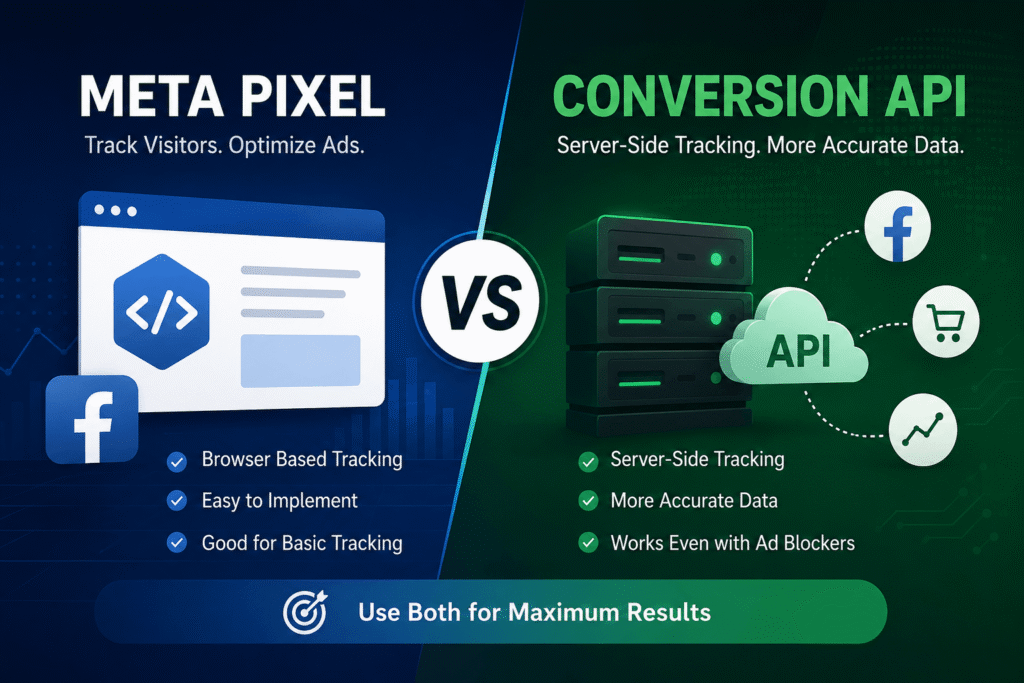
Meta Pixel and Meta Conversions API both help send website event signals to Meta, but they use different paths. Meta Pixel is mainly browser-side tracking that runs on the website. Conversions API provides a server-side or integration-based path for sending supported event data. They are not universal replacements for each other; in many setups, they can work together when events are configured and deduplicated correctly.
What is Meta Pixel?
Meta Pixel is a browser-side website tracking tool from Meta. It can help measure visitor actions such as page views, content views, leads, contact actions, add-to-cart events, checkout activity, purchases, and other configured events.
Because Pixel runs in the browser, it can be affected by browser behavior, script loading, consent choices, ad blockers, page setup, and implementation quality.
What is Meta Conversions API?
Meta Conversions API, often called CAPI, is a way to send supported event data from a server, website platform, partner integration, or another approved connection to Meta. It can provide an additional event path for important customer actions instead of relying only on browser-side tracking.
Detailed CAPI advantages and limits belong in the dedicated Conversions API benefits and limitations article.
Meta Pixel vs Conversions API: key differences
The main difference is the event path. Pixel sends browser-side event information from the visitor’s browser. Conversions API sends supported event information from a server-side or integration-based path.
- Event path: Pixel is browser-side; CAPI is server-side or integration-based.
- Browser dependence: Pixel depends more on browser execution; CAPI can reduce reliance on browser-only signals where implemented correctly.
- Setup context: Pixel is often simpler to add; CAPI usually needs more careful configuration, data handling, and verification.
- Combined use: Pixel and CAPI can work together when corresponding events are planned and deduplicated properly.
Does Conversions API replace Meta Pixel?
Conversions API does not universally replace Meta Pixel. Many businesses use both because each can send event signals from a different path. Pixel can still provide browser-side context, while CAPI can support an additional event path when the site or platform can send suitable data.
CAPI should not be treated as a magic fix. It does not guarantee complete attribution certainty, recover every event, or create better campaign outcomes by itself.
How Pixel and Conversions API can work together
When Pixel and CAPI are used together, the goal is usually to create a stronger event-signal foundation. Browser events and server or integration events can support each other, but the setup must be planned and tested carefully.
If both paths send corresponding versions of the same customer action, deduplication helps Meta understand that those events represent the same action instead of separate actions.
When might Pixel alone be enough?
Pixel alone may be enough for simpler websites, early testing, basic audience building, or campaigns where the business is not ready for a more technical tracking setup. It can also be the practical starting point when server-side access or partner integrations are not available.
When might Pixel plus CAPI be considered?
Pixel plus CAPI may be worth considering when advertising decisions depend on leads, purchases, checkout events, contact actions, or other conversion signals that need stronger measurement resilience.
It may also be relevant for e-commerce, lead generation, CRM-connected funnels, landing pages, and businesses that need cleaner event signals before scaling campaigns. For WooCommerce-specific context, use the WooCommerce tracking setup guide.
Benefits and limitations of CAPI
CAPI can improve event-signal resilience and support a stronger tracking architecture when implemented correctly. It does not create perfect tracking, remove consent obligations, guarantee attribution accuracy, or guarantee better business results. For the deeper explanation, read Meta Conversions API benefits and limitations.
Implementation and verification
A Pixel and CAPI setup should be verified before campaign decisions depend on it. Important checks may include whether intended events fire, whether corresponding events are deduplicated where needed, whether diagnostics show issues, and whether platform data is interpreted alongside website or business records.
If your business needs help planning Meta Pixel, Conversions API, events, deduplication, GA4, Google Tag Manager, or tracking diagnostics, see the Meta Pixel, Conversions API and tracking setup service.