
Ecommerce advertisers often ask one budget question too early: "How much should we spend?"
A better first question is: "Are we testing, or are we scaling?"
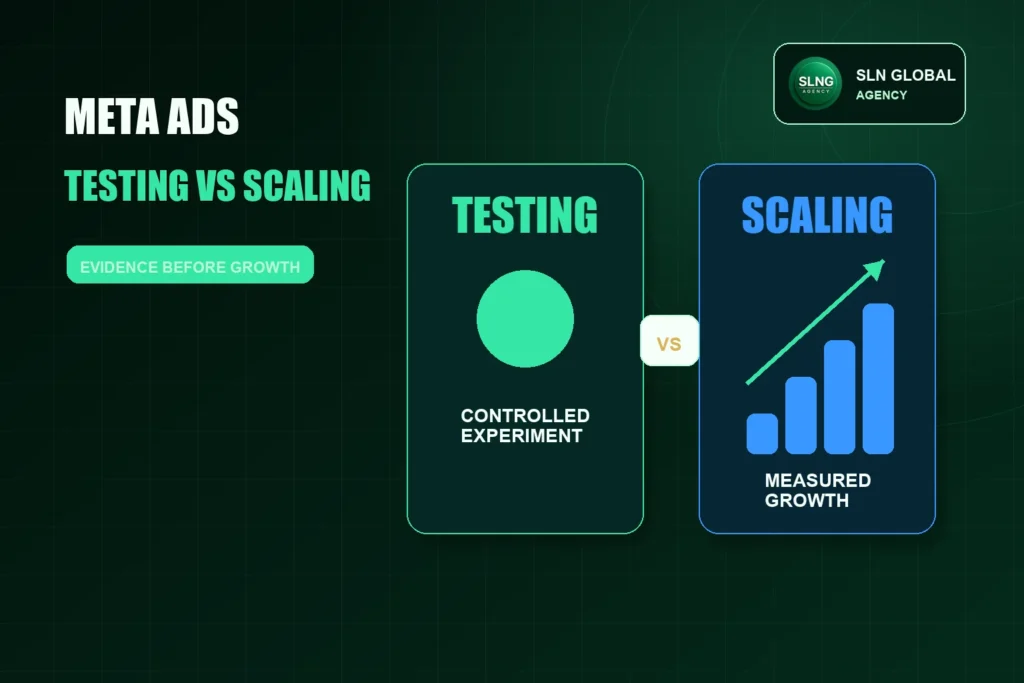
Testing budget and scaling budget have different jobs. A testing budget is used to learn whether an offer, product, creative angle, audience direction, product page, and tracking setup are strong enough to trust. A scaling budget is used to increase spend behind a path that already has enough evidence, operational support, and measurement confidence.
If a store treats testing like scaling, it can spend too much before the basics are proven. If it treats scaling like testing, it may keep budgets too small after finding a workable growth path.
What a testing budget is supposed to learn
A testing budget is not just a smaller budget. It is a controlled budget used to answer specific questions.
For ecommerce, testing should help identify:
- Which products or offers attract real buying interest.
- Which creative angles bring shoppers with intent.
- Whether the product page can turn traffic into cart, checkout, and purchase actions.
- Whether purchase tracking, value tracking, and order records are reliable enough to compare.
- Whether the business economics can support paid acquisition.
Testing is useful when the question is still uncertain. The goal is not to force scale early. The goal is to learn what should be improved, continued, paused, or expanded.
What a scaling budget is supposed to do
A scaling budget is used after the business has stronger evidence.
Scaling asks a different question:
Can we increase spend while keeping performance, product availability, fulfillment, customer support, and economics healthy?
Before scaling, review:
- Purchase volume and consistency.
- Cost trend across more than one isolated result.
- Average order value.
- Gross margin and contribution margin.
- Delivery, fulfillment, payment, return, refund, or cancellation costs.
- Product availability.
- Creative fatigue and creative supply.
- Tracking reliability.
- Customer support capacity.
Scaling is not only an ad-platform decision. It is an ecommerce operations decision.
Do not mix testing and scaling decisions
Testing and scaling can use similar campaigns, but the decision logic is different.
| Budget stage | Main purpose | Main risk |
|---|---|---|
| Testing budget | Learn which offer, product, creative, page, and tracking signals are promising | Ending tests too early or spending on unclear signals |
| Scaling budget | Increase spend behind a validated path | Increasing spend faster than performance, tracking, inventory, or operations can support |
If a campaign has not proven its basic economics, scaling can amplify waste.
If a campaign has proven a workable path and the business keeps it in testing mode forever, growth may stall.
Before testing, check tracking and economics
Testing should not start with budget alone. It should start with measurement and business context.
Check whether:
- Purchase events fire only after real completed orders.
- Value and currency are passed consistently.
- Browser and server events are not double-counting the same purchase.
- Shopify, WooCommerce, CRM, or order records can be compared logically with Meta reporting. If reports disagree, see why Meta and website numbers do not match.
- The store knows the rough margin available after product cost, payment cost, delivery, returns, discounts, and support.
If the business does not know what a profitable order looks like, it is difficult to know whether a test is working. For implementation support, review SLN's Meta tracking setup service.
During testing, control what you are trying to learn
Testing becomes messy when too many things change at once.
A cleaner test usually defines the main learning goal first:
- Are we testing a product?
- Are we testing a creative angle?
- Are we testing a landing or product page?
- Are we testing an offer?
- Are we checking whether tracking and store data agree closely enough?
The budget should match the learning goal. A test does not need to answer every business question at once. It needs to create enough evidence for the next decision.
Before scaling, review evidence and business capacity
Do not scale just because one day looked strong.
Look for evidence such as:
- Results that are not dependent on one accidental spike.
- Consistent store-side order data.
- A product page that is converting enough qualified visitors.
- Creative performance that is not already fading.
- Stock and fulfillment capacity.
- Support capacity for more customers.
- A realistic view of margin after ad cost.
If these areas are weak, the better move may be tracking repair, creative refresh, product page improvement, or offer refinement before increasing budget.
Understand ecommerce economics before increasing spend
Ad platform metrics do not tell the whole business story.
An ecommerce store should understand:
- Average order value.
- Gross margin.
- Contribution margin after variable costs.
- Shipping and delivery cost.
- Payment fees.
- Return, refund, cancellation, or failed-delivery risk.
- Customer support cost.
- Repeat purchase potential.
- Allowable acquisition cost.
A campaign can generate purchases and still be financially unhealthy. For example, a cost per purchase may look acceptable in Ads Manager, but the order can still be weak after discounts, shipping, product cost, and returns.
Budget decisions should be connected to real store economics, not only to platform-reported results.
ROAS is not the same as profit
ROAS is useful, but it is not profit.
ROAS compares attributed revenue with ad spend. Profit depends on margin, cost of goods, delivery, payment fees, discounts, refunds, cancellations, overhead, and customer support.
A higher ROAS can still be weak if margins are thin. A lower ROAS can sometimes be acceptable if margins, repeat purchases, or average order value are strong enough. The correct target depends on the business model.
For that reason, ecommerce stores should avoid copying another advertiser's budget or ROAS target without checking their own economics.
Scaling is not always linear
More budget does not always produce the same efficiency.
As spend increases, the campaign may reach broader or less ready audiences. Creative can fatigue. Inventory constraints can appear. Customer support can slow down. Fulfillment quality can drop. Tracking gaps can become more expensive.
This is why scaling should be monitored as a business system, not only as an Ads Manager setting.
Good scaling usually asks:
- Are incremental orders still valuable?
- Is cost rising faster than the business can absorb?
- Is the creative pipeline strong enough?
- Is the product page still converting?
- Are customers receiving the product and support experience the brand promised?
Budget changes and learning signals
There is no universal rule that every ecommerce advertiser should increase budget by the same percentage on the same schedule.
A gradual increase can be useful when the business needs stability, the campaign is still collecting signals, or fulfillment and margin need close monitoring.
A larger increase may be considered only when evidence is stronger, creative supply is healthy, stock and fulfillment are ready, and the business accepts higher risk.
The key is not the exact percentage. The key is whether the budget change matches the evidence and the business's ability to handle more volume.
A practical diagnostic table
| Situation | Likely decision |
|---|---|
| Tracking is unreliable | Fix tracking before trusting budget decisions |
| Clicks are coming but add-to-cart or checkout actions are weak | Review product page, offer, pricing, trust, and mobile experience |
| One creative produced most results and performance is fading | Refresh creative before scaling further |
| Orders are coming but margin is weak | Review product economics before increasing spend |
| Results are promising but sample size is thin | Continue controlled testing instead of aggressive scaling |
| Results are consistent and operations are ready | Consider measured scaling with close monitoring |
| Support, stock, or fulfillment is strained | Pause scaling until operations can support demand |
What not to do
Avoid these budget mistakes:
- Do not scale from one good day alone.
- Do not copy another store's budget without checking your own economics.
- Do not treat ROAS as profit.
- Do not ignore tracking mismatches between Meta, the store, and analytics.
- Do not increase spend if the product page is clearly weak.
- Do not scale with only one tired creative.
- Do not spend more than the business can operationally support.
Sometimes the right answer is not more budget. It is better tracking, better creative, a stronger product page, a clearer offer, or cleaner fulfillment.
When ecommerce stores should get help
Budget planning becomes more important when ads, product pages, tracking, and operations all affect the decision.
SLN's ecommerce growth and performance marketing support connects Meta ads, product or landing pages, tracking, reporting, and follow-up systems so budget decisions are based on clearer signals. Teams can also review the Meta advertising service and the ecommerce Meta advertising case study for related context. For more articles, visit Ecommerce Marketing resources.
Testing should help the business learn. Scaling should happen only when the campaign and the business are ready to carry the extra spend.