
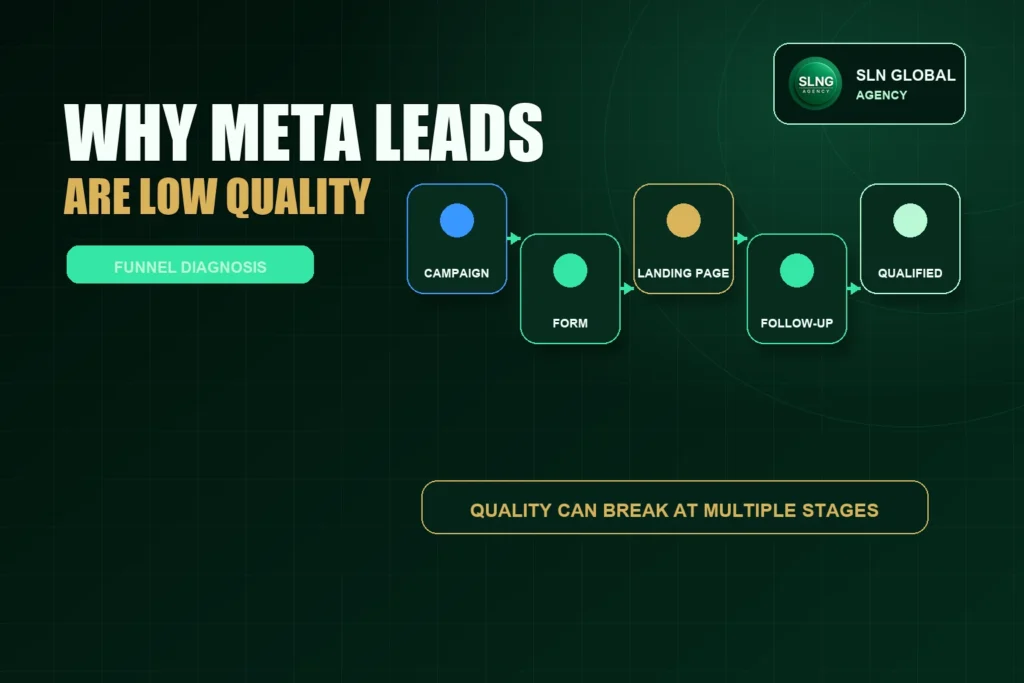
Low-quality Meta leads are frustrating because the campaign can look active while the sales outcome feels weak. The form fills up, but people do not answer calls. Messages arrive, but many are not serious. Cost per lead may look attractive, but the business does not see enough qualified conversations.
The mistake is assuming there is one universal cause.
Lead quality is shaped by the whole path: campaign setup, offer, ad promise, creative, lead capture method, qualification friction, response speed, follow-up process, and how the business defines a qualified lead.
Meta can generate demand and capture interest, but Meta does not control the full sales process after someone submits interest.
1. Define what low-quality lead means
Before changing the campaign, define the problem clearly.
Low quality can mean different things:
- Invalid: the contact detail is fake or unusable.
- Unreachable: the person may be real, but the business cannot reach them.
- Duplicate: the same person submitted more than once.
- Irrelevant: the person is real, but not a fit for the offer, location, or product.
- Low intent: the person is curious but not ready for a sales conversation.
- Unqualified: the person does not meet the business's budget, timing, eligibility, or need.
- Poorly handled: the lead was real, but follow-up was late, unclear, or inconsistent.
These are not the same problem. Each one points to a different fix.
2. Separate lead submission from business outcome
A lead is not automatically a qualified lead.
Use a simple stage ladder:
| Stage | Meaning |
|---|---|
| Lead submitted | Someone sent contact details or started a contact path |
| Contactable lead | The business can reach the person |
| Relevant lead | The person matches the offer, location, or need |
| Qualified lead | The person fits the criteria and shows serious intent |
| Sales opportunity | The conversation has real commercial potential |
| Customer or sale | The final business outcome |
If the business judges campaign success only by lead count or cost per lead, it may miss the real quality issue.
3. Diagnose the symptom before changing campaigns
Do not rebuild the whole campaign before identifying the failure point.
| Symptom | Possible funnel stage | What to inspect | What not to assume |
|---|---|---|---|
| Many leads, few reachable | lead capture / contact data / follow-up | form fields, phone validation, response process | Meta intentionally sent fake leads |
| Reachable but irrelevant | audience / ad message / offer / qualification | ad promise, targeting, location, eligibility questions | broad targeting is always the cause |
| Interested but not ready | offer / intent / funnel stage | price clarity, next step, urgency, buying readiness | all leads are bad |
| Qualified but no sales | sales process / pricing / follow-up | first response, objection handling, offer fit | campaign settings alone will fix it |
| High page abandonment | landing page / mobile experience / message match | speed, layout, trust, form friction | landing pages are always worse |
| High CPL but stronger conversations | qualification / intent | qualified rate, opportunity rate, sale rate | high CPL is automatically bad |
| Low CPL but weak sales | volume optimization / weak filtering | contact rate, qualified rate, cost per qualified lead | low CPL is automatically good |
This diagnostic step prevents random changes.
4. Check campaign and optimization factors
Campaign setup can influence the type of lead the system finds, but it is rarely the only factor.
Review:
- What result is the campaign optimizing for?
- Which conversion location or lead destination is used?
- Is the audience too broad, too narrow, or mismatched with the offer?
- Is the geography or service area correct?
- Is the campaign learning from enough useful signals?
- Are you optimizing for lead volume when the business needs stronger qualification?
Avoid universal assumptions. Broad targeting, algorithmic targeting, or a specific objective does not automatically mean bad leads. The question is whether the campaign setup matches the business's real qualification criteria.
5. Check ad and offer expectation
The ad creates the expectation before the form or page does anything.
Review:
- Does the creative show the real product, service, or outcome?
- Does the copy speak to the right buyer?
- Is price, location, delivery, eligibility, or next step clear where it matters?
- Is the offer attracting serious prospects or casual curiosity?
- Does the ad promise match what happens after submission?
If an ad attracts curiosity but the business requires high purchase intent, high lead volume can coexist with weak downstream qualification.
6. Review the lead capture method
Meta leads can come through different paths, such as Instant Forms, website forms, messages, calls, or other lead destinations depending on the campaign setup.
This article is not a lead-path comparison. If the main question is which route to use, compare Instant Form vs landing page vs WhatsApp lead paths separately.
For diagnosis, ask:
- Is the capture method aligned with the offer?
- Does it collect enough information to qualify the person?
- Is it easy enough for real prospects to complete?
- Is it too easy for casual or mistaken submissions?
- Does the person understand what will happen next?
The right path depends on the offer, price point, market, sales process, and follow-up capacity.
7. Review Instant Form friction and qualification
Instant Forms can reduce friction. That can be useful when the business needs fast mobile-friendly submission.
Lower friction can also create a trade-off: more volume may require stronger filtering and faster follow-up.
Review:
- Are the questions too generic?
- Are qualification questions aligned with the offer?
- Does the form explain what happens next?
- Is there a review or higher-intent step where appropriate and available?
- Are there too many questions for the stage of the funnel?
More questions are not automatically better. Too many questions can reduce volume. Too few questions can increase weak leads. The right balance depends on the offer and sales capacity.
8. Review landing page factors
If the campaign sends people to a landing page, quality can fall when the page does not match the ad. When the page itself needs improvement, review landing page development for leads and sales separately.
Common problems:
- The headline does not match the ad promise.
- The form asks too much too early.
- Mobile layout is hard to use.
- Pricing, delivery, location, or next step is unclear.
- The page looks less credible than the ad.
- The call-to-action is hidden or repeated without context.
A landing page is not automatically better than an Instant Form. It can help qualify and educate, but only if the page is clear, fast, trustworthy, and aligned with the ad.
9. Review response speed and first contact
Lead response matters because interest can fade quickly.
A person may submit a form while comparing multiple businesses. If follow-up happens much later, the lead may not remember the ad, may have chosen another provider, or may no longer be in the same buying moment.
Check the real process:
- How quickly does the first call or message happen?
- Who owns the response?
- Is there a backup if the lead does not answer?
- Are follow-up attempts tracked?
- Are missed calls or unread messages reviewed?
- Is the first response aligned with the ad promise?
Many "bad leads" are actually cold follow-up processes.
10. Check sales handling and lead status feedback
If the sales or moderator team does not know what the ad promised, the conversation can break.
Make sure the person handling leads knows:
- which ad or offer generated the lead;
- what the person expects;
- which qualification questions were already answered;
- what the next step should be;
- what objections are common;
- how to record the outcome.
Where the business has a CRM or lead-status workflow, record statuses such as contacted, unreachable, irrelevant, qualified, opportunity, won, or lost. For measurement support, review tracking and lead-quality measurement as a separate workflow. Down-funnel feedback helps the business understand whether the issue is campaign quality, capture quality, sales handling, or final offer fit.
Do not treat CRM feedback or server-side lead events as a quick setting change. They require careful setup and clean definitions.
11. Measure quality beyond CPL
Cost per lead is only one metric.
Also review:
- contact rate;
- valid contact rate;
- qualified lead rate;
- appointment or opportunity rate where relevant;
- sale or customer rate;
- cost per qualified lead;
- cost per customer where measurable.
A low CPL can be commercially poor if most leads are invalid, unreachable, or unqualified. A higher CPL is not automatically better either. The real question is whether the campaign creates enough qualified opportunities at a sustainable cost.
12. What to test first
Start with the highest-confidence bottleneck:
- If leads are invalid or unreachable, inspect form fields, contact validation, and follow-up process.
- If leads are relevant but hesitant, inspect offer clarity, price clarity, and first response.
- If leads are irrelevant, inspect ad message, targeting, geography, and qualification questions.
- If leads are qualified but do not buy, inspect sales handling, pricing, objection handling, and follow-up cadence.
- If results are hard to interpret, separate submitted leads from qualified leads and final outcomes.
Do not change five things at once. Change one part of the funnel, then compare downstream quality, not only CPL.
When to get help
Ask for help if:
- the business gets many leads but few qualified conversations;
- sales or moderators cannot tell why leads are rejected;
- lead path, tracking, and follow-up data do not connect;
- CPL looks good but cost per qualified lead is poor;
- the team is unsure whether the issue is campaign setup, form/page friction, or follow-up.
SLN's Meta advertising support can help review the ad promise, lead capture path, landing page, tracking, and follow-up process so lead quality can be diagnosed instead of guessed.
Better leads rarely come from one magic setting. They come from a clearer path from ad promise to qualified sales conversation.
For related campaign guidance, see Facebook Ads resources.